




Delivering Value Beyond Savings; Future-proofing Agency Rosters

What do marketers want? Outstanding creativity. That remains the constant. But how do you future-proof marketing agency rosters?
What has changed is the environment in which that creativity must be delivered. Marketing today is always-on, platform-driven and increasingly shaped by data, technology and AI. Brands are under intense pressure to deliver short-term performance while continuing to build long-term brand value. Against this backdrop, it’s striking how many organisations are still operating agency rosters designed for a very different era.
The consequence is familiar: complexity, duplication, slow decision-making and frustrated marketing teams spending too much time managing agencies and not enough time focusing on creative excellence. This is where procurement can, and should, play a much more strategic role.
Moving beyond savings as the definition of value
Historically, procurement’s involvement in agency management has been synonymous with cost control. While financial discipline remains essential, it is no longer sufficient. Marketers are not asking procurement to simply make agencies cheaper; they are asking for quality, speed, relevance and strategic value.
Modern procurement has a critical opportunity to reframe the conversation around “value beyond savings”. Well-designed agency rosters can unlock better creativity, improve speed to market, reduce wasted production and enable more integrated, customer-centric outputs. In short, they can make marketing work better.
Start with strategy, not structure
Future-proofing an agency roster still starts with first principles. Roster design should be led by business strategy and marketing ambition – not by legacy contracts or prevailing industry trends.
Is the business focused on growth through new markets, new channels or new audiences? Is e-commerce, retail media or experience design a priority? Is the organisation balancing brand building with performance marketing? These strategic choices have direct implications for the capabilities, scale and flexibility required from agency partners.
From this understanding, organisations can develop clear roster design principles -guardrails that define what “good” looks like for their specific context.
Understand where growth will really come from
The next step is a deeper exploration of what will drive growth in the sector and the organisation. For many brands, this now includes mass personalisation, creator ecosystems, premiumisation, community building or AI-enabled optimisation. Each of these places very different demands on agency partners.
A roster built for traditional campaign advertising will struggle to support these growth drivers without becoming bloated or inefficient. Procurement and marketing must work together to align roster capabilities with the realities of how marketing value is created today.
Be honest about current ways of working
A hard look inward is essential. How effectively do internal teams work with agencies? Where do bottlenecks occur? What gets duplicated? Where are briefs unclear or feedback cycles broken?
Understanding current behaviours and organisational blockers helps identify what needs to change – not just externally, but internally. For procurement, this stage also requires a clear and credible view of agency costs, enabling informed trade-offs between different operating models rather than blunt cost-cutting.
Designing rosters that can actually work
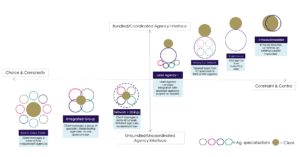
Armed with this insight, organisations can define and test a roster model that fits their needs. Importantly, there is no universally “right” model. In-housing, lead agencies, specialist partners, flexible studios and creator networks can all play a role.
The danger lies in trend-chasing – adopting a model because it is fashionable rather than fit-for-purpose. The most effective rosters are often bespoke and hybrid, combining stability where it matters with flexibility where it adds value.
But design alone is not enough. Roster success depends on how it is operationalised: governance, ways of working, collaboration between partners, and integration with martech, data and AI tools.
Insight, data and AI as value multipliers
One of the most powerful but often under-invested sources of value is insight. In today’s environment, insight is not just research; it is continuous learning powered by data, analytics and increasingly AI.
Strong insight capability ensures agency rosters are customer-centric and outcome-led. It reduces wasted production, improves creative relevance and creates a virtuous loop where learning informs strategy and execution. While investment may be required, insight is one of the clearest ways to deliver value.
Measuring what really matters
Any future-fit roster must be supported by a clear measurement framework. Cost efficiency is important, but it is only part of the story.
Value should be measured through a mix of hard and soft metrics: quality and consistency of output, speed to market, integration across channels, right-first-time delivery, and ultimately impact on brand and customer outcomes. Agency performance management should focus on contribution, not just compliance.
The final truth
Even the best-designed agency roster will not transform an organisation that lacks the internal capability to use it well. Future-fit rosters require future-fit clients.
When procurement and marketing align around a shared definition of value – one that goes beyond savings – agency rosters become a strategic asset. Done well, they don’t just control cost; they enable outstanding creativity and sustainable growth.
For more details of the Observatory International’s agency roster modelling capabilities and practice please click here.